Creating a cosy and calm EYFS Classroom; A Blog Post by Sophie @MrsG _EYFS
For many people, EYFS is seen as chaotic, noisy and perhaps even a little daunting. It’s often the phase that many teachers fear stepping into. But in my classroom, we’re striving for the opposite. As we move towards September, our focus is on creating a cosy, calm environment where children feel safe, comfortable and ready to learn.
Recently, I stumbled across the Danish concept of hygge. I know this won’t be a new idea for everyone, but for me it sparked a curiosity that encouraged me to explore it in more depth. I wanted to understand how I could bring elements of this approach into my classroom and create a space that felt warm, welcoming and nurturing.
As I began researching, I quickly realised that many aspects of hygge were already present in our environment. With a few thoughtful tweaks to resources and routines, I could build on what was already there and create a classroom that truly supports children to flourish.
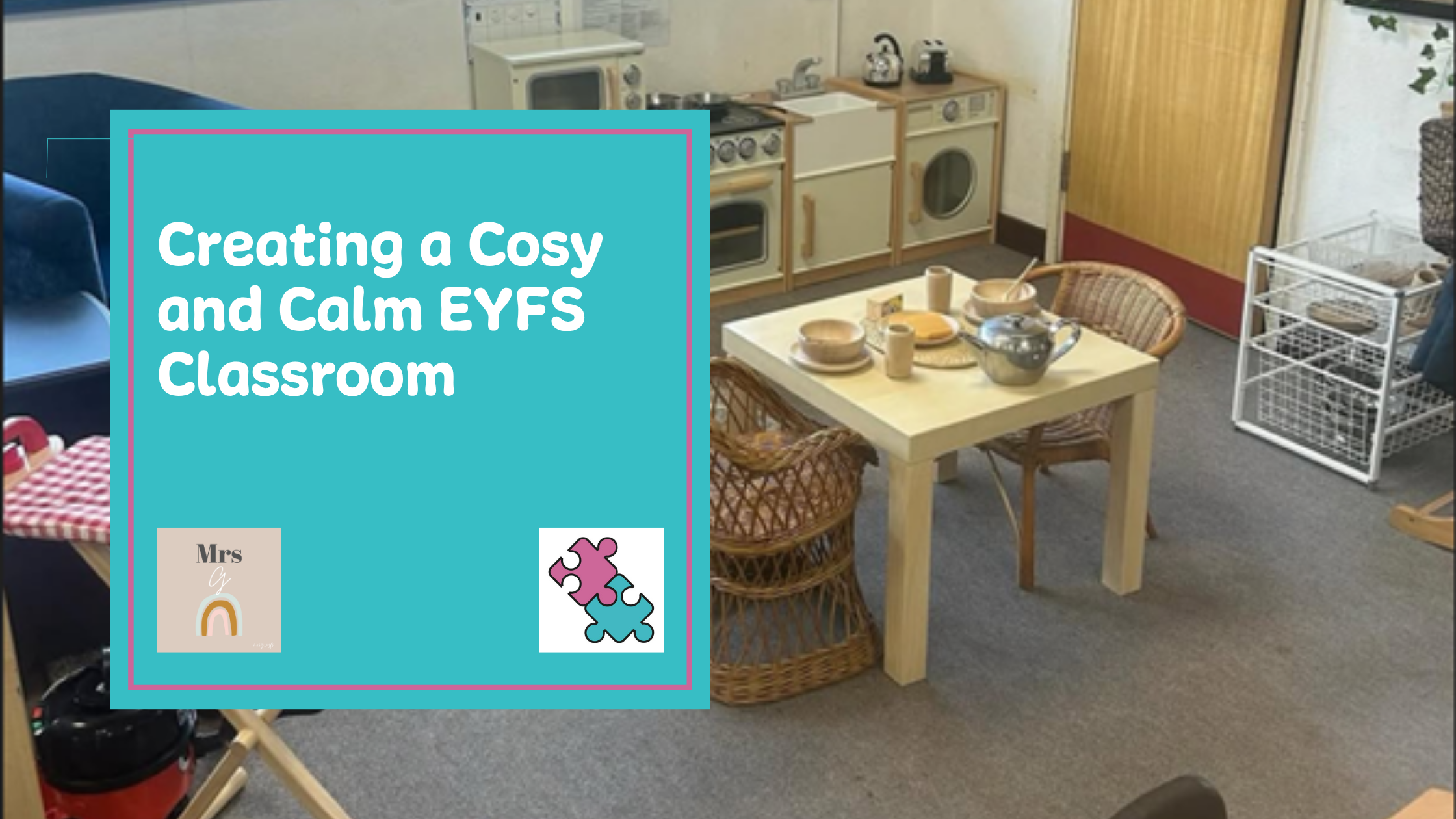
Of course, every teacher is different and every classroom has its own personality. What works for one setting won’t necessarily work for another. However, I’ve always found that too much colour and visual stimulation can quickly become overwhelming. Since joining my current setting, we have intentionally kept our environment as neutral as possible. Hessian display boards, wooden loose parts and wicker or clear storage baskets help to create a calmer aesthetic. As a self-confessed plant killer, I’ve opted for artificial greenery, but even a few potted plants can help soften a space and make it feel more inviting.
As a trust, we have also moved away from heavily planned tuff tray and tabletop activities. Instead, we have focused on strengthening our continuous provision, ensuring children have opportunities to revisit, practise and deepen their learning through meaningful experiences and carefully considered provocations.
We’ve also paid closer attention to the resources within our provision. Small-world figures are realistically scaled, so no giant insects sitting next to tiny tigers, and resources are clearly labelled using photographs and shadow labels. These small changes not only support independence but also help children care for their environment and engage with resources in a calmer, more purposeful way.
During the hectic final half term of the year, I decided to trial some of my new ideas with my class. Rather than waiting until September, I wanted to see whether these changes would genuinely make a difference.
One of the first things we did was stop using the main classroom lights. Instead, we relied on softer, warmer lighting from fairy lights and battery-operated candles. During provision time, calming music played quietly in the background, while images of woodlands and natural landscapes were displayed on the screen. I also made a conscious effort to make our outdoor area more accessible throughout the day.
The impact was almost immediate.
The noise levels dropped significantly. Children began moving towards one another to talk rather than calling across the room. Interactions felt calmer and more respectful. There was a noticeable shift in the overall atmosphere of the classroom.
We also introduced an oil diffuser using calming scents such as vanilla and lavender. The children loved trying to guess which scent was being used that day, and it quickly became part of our routine. While none of these changes were revolutionary on their own, together they completely transformed how the classroom felt.
It confirmed for me that this is an approach I want to embrace fully in September.
However, as I continued learning about hygge, I realised that it isn’t simply about fairy lights, cushions and natural resources. Whilst the environment plays a huge role in creating a calm classroom, hygge is also about connection.
Some of the cosiest moments in our day aren’t linked to resources at all. They’re found in sharing a story together, chatting over snack time, celebrating a small achievement or simply sitting alongside a child who needs a little extra reassurance. Creating a sense of belonging is just as important as creating a beautiful environment. Children thrive when they feel seen, valued and connected, and for me that sits at the heart of everything we do in Early Years.
One of the biggest lessons I’ve learnt through exploring this approach is that creating calm isn’t just about how a classroom looks—it’s also about the pace of the day. As teachers, we can become caught up in moving children quickly from one thing to the next. There is always another activity, another task or another objective waiting around the corner. Hygge has reminded me of the importance of slowing down; allowing children time to become deeply involved in their play, linger over a story or simply enjoy a moment of wonder.
I’ve also become more intentional about connecting children with nature. There is something incredibly calming about the natural world. Whether it’s watching leaves blow in the wind, listening to birdsong in our outdoor area or examining a collection of pinecones and conkers, children seem naturally drawn to these experiences. Bringing elements of nature into the classroom helps blur the boundaries between indoors and outdoors and creates an atmosphere that feels peaceful and grounding.
Perhaps the biggest surprise for me wasn’t how the classroom looked after making these changes—it was how it felt. I found myself feeling calmer too. The softer lighting, quieter atmosphere and slower pace didn’t just benefit the children; they helped me enjoy being in the classroom more as well. During one of the busiest points of the school year, I found myself taking a breath, slowing down and appreciating the small moments that can so easily get lost in the rush of everyday school life.
One of my biggest concerns when planning a cosy and calming environment was, of course, budget. How much was all of this going to cost?
The reality is that creating a hygge-inspired classroom doesn’t have to be expensive. While I am fortunate to receive a classroom budget each year, many of my favourite additions have come from charity shops, car boot sales and Facebook Marketplace. If you’re willing to spend a little time searching, you can find some incredible bargains. Recently, I picked up two children’s wicker chairs for just £10—a purchase I’m still rather pleased with!
Perhaps the biggest lesson I’ve learned through this process is that a classroom doesn’t need to be Pinterest perfect.
Those of you who follow me on Instagram (@MRSG_EYFS) will know that my classroom is never flawless. Social media can sometimes create the expectation that every corner should be beautifully styled and every resource perfectly displayed. While I love sharing ideas online, I constantly remind myself that my classroom isn’t designed for Instagram.
It’s designed for children.
If a space feels warm, welcoming and engaging, then it is doing its job. If children feel calm enough to take risks in their learning, confident enough to explore independently and secure enough to be themselves, then that matters far more than whether every basket matches or every shelf looks picture-perfect.
At the heart of hygge is the idea of comfort, connection and wellbeing. As educators, those are exactly the things we want for the children in our care. So, as I prepare my classroom for another year, I’m not aiming for perfection. I’m aiming for a space where children feel calm, safe and truly at home.
If a space helps children to build relationships, develop confidence and engage deeply in their learning, then it is already successful. The wicker baskets, fairy lights and neutral colours are simply tools to help us create that feeling.
In a world that often feels busy, noisy and rushed, perhaps what our youngest learners need most is a place that feels calm, connected and safe. A place where they can simply be children.
Maybe creating a calm classroom isn’t about adding more at all. Maybe it’s about stripping things back and making room for what matters most.
MrsG has been teaching in Primary Schools, specialising in EYFS and KS1 for the last 13 years. She has taught across both key stages working as an Assistant Head, before heading back into the classroom full time after having her children. MrsG is now Senior Teacher in a small school, where she teaches in EYFS. She also works with ECTs supporting them with planning, workload, job applications and interview technique through her Instagram account instagram.com/mrsg_eyfs